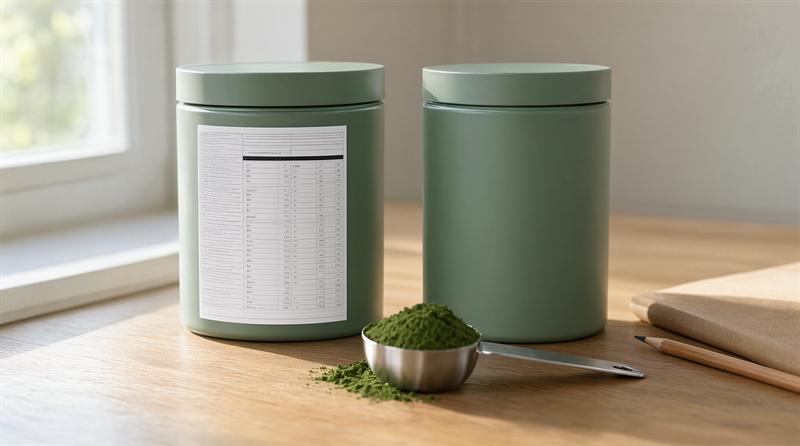
Two tubs sit on the same shelf with almost identical wording on the front and very different panels on the back. Learning how to read a greens powder label is mostly a matter of knowing which lines carry the useful information and which are decoration.
The order of a Supplement Facts panel is not arbitrary. Read it in sequence and a crowded label becomes a short set of questions you can answer in a few minutes. In the United States, supplements are regulated as part of the food supply rather than as medicines, which is why the arithmetic on the panel carries more weight than the adjectives on the front.
Start With the Serving Size, Because Every Number Depends On It
The serving size sits at the top of the panel because every number below it is measured against that scoop. On a supplement, the maker sets the serving size rather than a government portion standard, so one tub may count a single scoop and the next may count two.
That is where most side-by-side mistakes begin. A product showing 200 mg per serving can look stronger than one showing 100 mg until you notice that the first counts two scoops and the second counts one. Servings per container plays the same trick in reverse: thirty servings at two scoops a day is fifteen days of powder, not thirty.
Scoops are not standard either. Two brands can print the same serving size and mean different volumes, so a level scoop from one tub may weigh half again as much as a level scoop from the next. That is one more reason to read the gram weight per serving rather than the scoop count alone.
If the category itself is still new, a complete guide to greens supplements covers what these products are for and how the main types differ. The panel makes more sense after that.
How to Read a Greens Powder Label, Step by Step
Most searches for “greens powder ingredients explained” are really two questions in one: what the plants are, and how much of them a scoop delivers. A greens supplement label answers the second, and it reads in a fixed order that makes the method repeatable.
- Serving size and scoops per day. The baseline for every figure that follows.
- Total grams of the green blend. How much of the scoop is plant material at all.
- Ingredient order. Ingredients appear in descending order by weight, so the first few lines say the most about the formula.
- Amount per ingredient. A formula that states each amount is easier to evaluate than one that does not.
- Add-in categories. Fiber, enzymes, probiotics, and flavor systems usually get their own rows.
- Other ingredients. The line that holds the powder together and helps it mix.
Once that order is familiar, the panel stops reading as a wall of text. For what each plant is, spirulina, chlorella, and barley grass explained one by one is the companion reference. This article stays on how the label reports them.
What a Proprietary Blend Hides, and How to Read Around It
A proprietary blend lists a group of ingredients with one combined weight and no individual amounts. That is legal, common in greens formulas, and the biggest single obstacle to comparing two tubs honestly.
The cost to a reader is arithmetic. Fifteen grams of blend spread across twenty ingredients averages under a gram each, and the panel cannot say which of the twenty carries most of that weight. A formula built around three or four named extracts may hold more of what you came for than one that lists twenty in a blend.
The practical move is to weigh blend grams against ingredient count, favor labels that disclose amounts per ingredient, and read a short specific blend as more informative than a long vague one.
The Dosage Column: Milligrams, Grams, CFU, and Activity Units
The dosage column mixes units because ingredients are not measured the same way. Fiber and grass powders are listed in grams, herbs and extracts in milligrams, probiotic cultures in CFU, and enzymes in activity units. A figure from one row does not compare to a figure from another.
What the number states is how much went into the scoop, not how much the body absorbs and not what effect it might have. More is not automatically better, and a smaller amount of a standardized extract is not automatically weaker. A number on a greens supplement label is a quantity, and reading it as an outcome is where expectations drift.
Two checks finish the column. Confirm the unit fits the ingredient, and confirm whether the figure is quoted per serving or per scoop before you compare it with anything else.
Add-Ins Worth Understanding: Fiber, Enzymes, Probiotics, and Sweeteners
Many greens powders are part greens, part digestive support, and part flavor system. None of that is a problem on its own. Not knowing which part is which is the part that costs you a clear comparison.
- Fiber. Adds grams and bulk, so the scoop’s weight is not all greens.
- Enzymes. Listed in activity units and usually a small share of the scoop.
- Probiotics. Listed in CFU, with a stability story the panel does not tell.
- Sweeteners and flavors. They make a daily habit easier, and they count toward the formula’s weight.
The question worth asking is whether the add-ins match the reason you are buying. Fiber and probiotics make sense in a formula chosen for digestive support. In one chosen for greens, the same add-ins may simply be taking up space.
Other Ingredients: Formulation, Not Automatically a Warning
The other-ingredients line covers what holds a powder together and helps it mix: anti-caking agents, flow agents, flavors, sometimes a sweetener. These appear in small amounts and are listed by weight like everything above them.
Read the line for what matters to you, whether that is a sweetener you avoid or a filler taking up weight you expected to be plant material. These same lines appear in every supplement category, so the habit carries over to the next bottle you pick up.
Reading the Front Panel Against the Back
The front of a tub is written to be read in three seconds. It may advertise a long list of superfoods, suggest a daily reset, or imply that one scoop stands in for several servings of vegetables. None of that appears on the panel, and the panel is where a claim either has a number behind it or does not.
The vegetable comparison shows why the distinction matters. A scoop is a measured weight of dried and powdered plants, while a serving of vegetables is a volume of fresh food carrying its own water content. The two are not interchangeable, and a greens powder works as support for a routine rather than a replacement for produce on the plate.
None of that is a reason to distrust every front panel. Read the front for the category — greens, digestive support, a specific body system — and the back for the arithmetic. When the two disagree, the back is the one that has to hold up.
Putting Two Tubs Side by Side
Normalize before comparing. Servings per container multiplied by grams per serving gives the actual amount of powder in the tub, which is the only fair basis for price or for any other calculation.
Then line up four rows: grams of greens per serving, whether individual amounts are disclosed, which add-in categories are present, and the number of servings in the tub. Cost per serving belongs in the same table when price is part of the decision. A five-step framework for comparing supplements turns those four rows into a process you can repeat on the next shelf.
The panel describes a formula, not a factory. Third-party testing marks, a stated manufacturing standard, and sourcing detail are separate statements, and they usually sit in another panel or on the product page rather than beside the ingredients. Those signals belong in the same comparison, even though they are not part of the arithmetic.
When It Helps to Talk the Label Through
Some labels resolve in five minutes. Others mix five purposes into one scoop, and at that point an hour more of reading rarely helps. A conversation about your goal tends to be faster.
The Herb Works Inc. offers a free first consultation, available Monday through Saturday by appointment only. The conversation follows three stages: a personal health assessment, customized recommendations, and ongoing support that monitors progress and adjusts the wellness plan as needed. A personalized plan includes recommended products and lifestyle adjustments.
The range covers supplements, herbal remedies, essential oils, and protein, arranged by body system. greens and herbal products on the shelves shows what is in stock, and booking a free consultation is the natural next step if the label is the part you would rather talk through.
Key Takeaways
- Serving size frames every other number, so compare per serving rather than per scoop.
- Blend weight divided across many ingredients is the real transparency question.
- Units differ by ingredient family, which makes milligrams, CFU, and activity units incomparable.
- Add-ins count toward the scoop rather than sitting on top of it.
- The other-ingredients line is formulation, and it is worth reading for what you avoid.
- Normalized servings are what make a side-by-side comparison honest.
Conclusion
A label is a description of a formula, and reading it in order turns a shelf of near-identical tubs into a short list. The aim is not the most impressive panel but the one that matches what you are actually trying to do.
The Herb Works Inc. runs the My Herbal Roots storefront in Lindon and Mapleton, Utah, and serves Utah County as well as clients nationwide. The shop has worked as a Nature’s Sunshine consultant since 1975, which is where the more than 50 years of herbal expertise comes from.